THE CATEGORY · SALESNAIL BY LONGARENA
B2B sales simulation training
Practice the decisions that shape a whole deal, not only the words in the next conversation. A sales simulation gives a team a shared customer situation, limited resources and consequences it can learn from.
What is a B2B sales simulation?
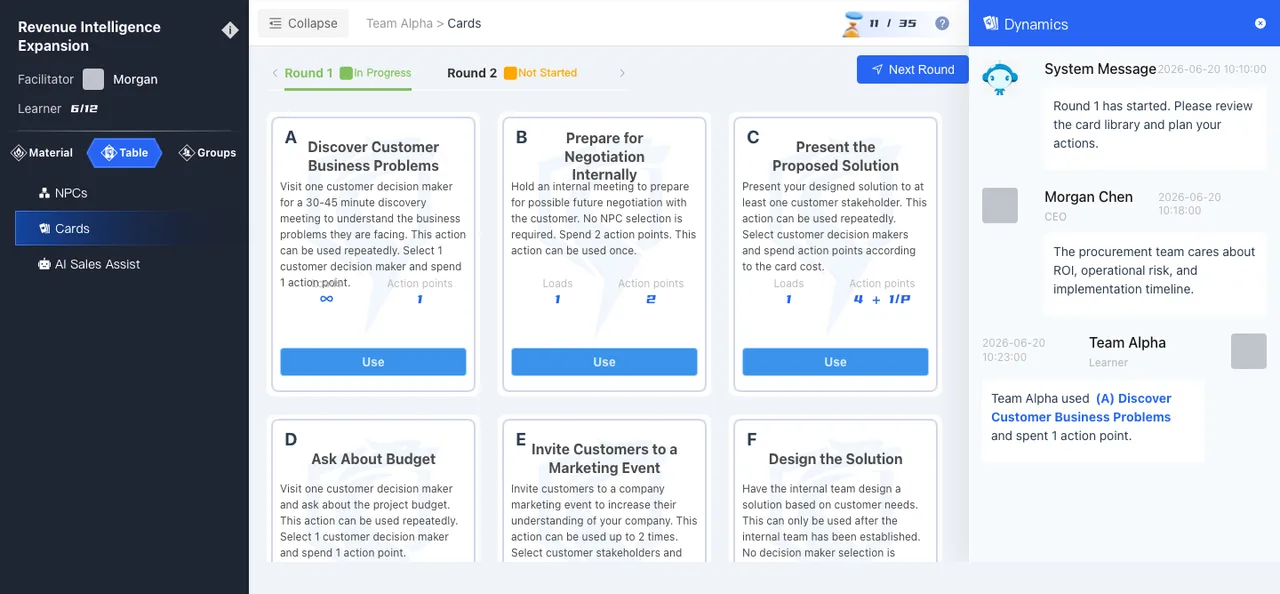
A B2B sales simulation is a structured practice environment in which participants make choices across a selling situation. Teams investigate customer needs, interpret stakeholder interests, allocate effort and advance opportunities. The scenario responds to those decisions over successive rounds.
Unlike a case discussion with a predetermined answer, participants have to choose an action with incomplete information. The facilitator can then connect the choices, available evidence and outcomes to a structured debrief. The purpose is better judgment, not simply winning a game.
What teams practice
Complex selling combines customer understanding with coordinated action. A simulation makes the connections visible: who the team listened to, what it assumed, where it spent resources and what it did when the opportunity changed.
- Customer discovery and business problem diagnosis
- Stakeholder coverage and decision-chain analysis
- Opportunity priorities, proposal choices and resource trade-offs
- Cross-functional team selling and evidence-based reflection
How a facilitated session works
Start with a learning objective and a scenario that fits the audience. The trainer reviews the business context, customer roles, opportunities, action cards and materials before inviting participants. Teams then work through staged rounds and compare decisions rather than only listening to a lecture.
SalesNail is commonly delivered as a one- or two-day rehearsal of a longer complex-sales cycle. The precise agenda, team size, materials and facilitator support are agreed for the engagement; the time compression is a learning design, not a promise of faster real-world deals.
Where AI helps — and where review stays human
AI helps create and adapt a business scenario to the seller, customer, industry and learning objective. That reduces repetitive preparation and lets the trainer focus on the context and choices worth practicing.
Generated content must still be checked before learners use it. A trainer reviews plausibility, role relationships, opportunity conditions and wording. Do not upload confidential customer information unless its use is approved and the applicable data arrangements have been checked.
When simulation is a useful fit
Use the format when the problem is shared judgment across a team: a sales kickoff, a complex key-account program or collaboration between sales and specialists. Individual dialogue roleplay may be a better fit when the goal is repeating a particular conversation or improving delivery.
Choose a scenario based on the decisions participants need to practice. Review an example, decide what evidence the debrief will use, and plan how lessons will be translated into customer work. A free story game is an entry point, not a substitute for that design.
Questions before you start
Is this a voice or cold-call coaching tool?
No. SalesNail focuses on decisions across a complex B2B deal, limited resources, team collaboration and facilitator-led debriefing. Conversation practice can complement it, but the platform is not presented as a voice-scoring service.
Can we evaluate it before arranging a workshop?
Chapter 1 of The Second Curve is free without sign-up. It demonstrates individual narrative and decision mechanics, not the complete facilitated team workshop. Discuss your team objective and delivery requirements separately.