BUYING GUIDE · DELIVERY AND COST
Plan the scope before comparing sales simulation prices
A software license and a facilitated workshop are not the same purchase. Compare your business objective, scenario customization scope, participant access and trainer responsibilities before evaluating enterprise sales simulation software quotes.
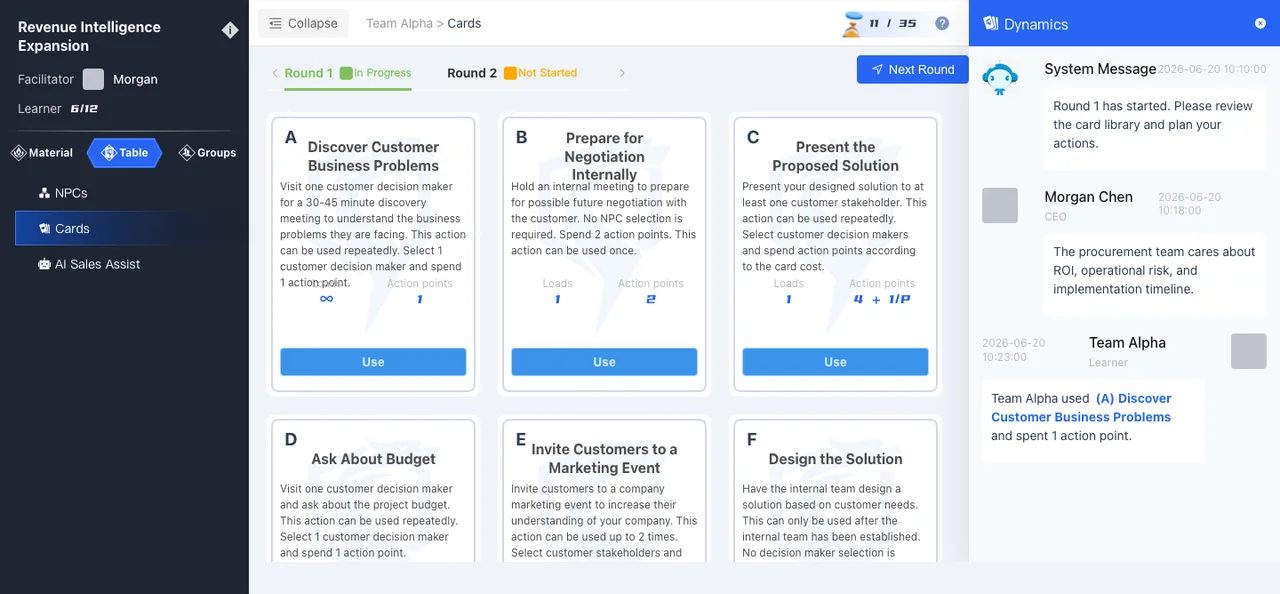
Separate the parts of the purchase
When procurement and sales enablement teams compare sales simulation pricing across vendors, apples-to-oranges quotes are the biggest source of confusion. Some vendors quote a per-seat SaaS subscription for solo AI roleplay minutes, while enterprise B2B simulation engagements combine software platform access with scenario preparation and expert facilitation.
Break your evaluation into three distinct cost components: (1) platform access and participant/team entitlements, (2) scenario selection or AI-assisted customization and human review, and (3) facilitator preparation, live delivery (remote or in-person) and post-round evidence debriefing. Clarifying who owns each component prevents surprise change orders.
Compare delivery scopes before requesting a quote
Different objectives call for different delivery scopes. Use the scope matrix below to align internal stakeholders before asking for a formal commercial proposal.
Scroll the table sideways to see all columns.
| Scope Tier | Best-Fit Use Case | Scenario Preparation | Facilitation & Debrief | Commercial Basis |
|---|---|---|---|---|
| Tier 1: Free Solo Preview (The Second Curve Ch. 1) | Individual buyer exploring decision mechanics | Fixed narrative chapter, no sign-up required | Self-guided interactive story | Free without sign-up |
| Tier 2: Standard Reviewed Scenario Workshop | SKO breakout, regional team alignment or pilot | Existing reviewed B2B industry scenario | Facilitator-led 1–2-day session & log debrief | Platform seats + agreed facilitator delivery |
| Tier 3: AI-Customized Enterprise Program | Key-account transformation or complex ICP rollout | AI-customized to your ICP, products & methodology + human review | Multi-cohort facilitation, train-the-trainer or partner enablement | Custom enterprise scope & commercial agreement |
What changes the delivery scope and preparation effort
Even within a facilitated workshop, preparation time varies significantly based on the complexity of the learning brief. An existing reviewed scenario requires minimal setup beyond participant onboarding, whereas a custom multi-product enterprise scenario involves aligning stakeholder motives, competitive battlecards and scoring rubrics.
Cohort size and delivery format also matter. Running four cross-functional pods of five participants in one room has different facilitation and debriefing demands than running twelve pods across global time zones.
- Existing reviewed scenario versus AI-customized ICP adaptation and trainer verification
- Number of competing teams, total participant seats and account entitlement duration
- Facilitator preparation, live delivery days and structured decision-log debrief scope
- Remote video breakout logistics versus on-site SKO or executive workshop support
- Any agreed train-the-trainer certification, internal champion coaching or follow-up review
Evaluate the learning design and evidence before the quote
Before comparing price per head, inspect the underlying learning mechanics. Ask to see how a customer round unfolds, what trade-offs force teams to debate, and how the platform records decisions for the facilitator debrief. High energy without diagnostic evidence leaves teams with a fun memory rather than a changed selling habit.
LongArena’s whitepaper project covers 78 training classrooms, 361 active teams and 19,733 approved simulation actions. The study is observational and the cohort is a convenience sample from training in China; it is not evidence of higher win rates or faster sales cycles.
For a pilot, ask the vendor to show the actual record a facilitator can use. For example, can they show which team consulted a budget owner before building a proposal, what the other team did instead, and what changed between rounds? Then decide what behavior a manager will help learners carry over to a live account, such as documenting the approval path before requesting technical resources.
Use a practical procurement and security checklist
Confirm buyer and trainer responsibilities early, including which business context is approved for scenario authoring. Use anonymized or fictionalized customer details unless confidential data handling has been explicitly reviewed and authorized in your commercial agreement.
Verify technical readiness (browser access, network policies and participant devices) ahead of live sessions, and request formal commercial terms covering platform access, cancellation/rescheduling policies and privacy documentation from your authorized provider.
- Confirm legal entity, authorized contracting party and applicable commercial terms
- Verify approved data inputs (anonymized ICP brief vs. restricted account material)
- Review facilitator credentials, dry-run schedule and debrief deliverables
- Test participant browser/network access prior to kickoff or workshop day
Compare two quotes for the same pilot
Give both providers the same group size, training objective and target date. Ask each to itemize scenario preparation, facilitator time, participant access and support. Confirm what changes if another cohort runs the same scenario, if the session moves online, or if you need to reschedule. A per-seat figure is not comparable until you know which items are included.
Separate one-time preparation from the cost of each delivery. Ask who can reuse the scenario and decision records after the pilot, under the applicable terms. This makes it easier to compare a single workshop with a program you intend to repeat.
Use the free first chapter for the right purpose
Play Chapter 1 of The Second Curve to see how choices have consequences in the story. It requires no sign-up. Use the related link below, then watch for the moment when you must decide whether to gather more information or act on what is already known.
Treat that solo preview as a mechanics check rather than a substitute for a multi-team enterprise classroom. When you are ready to scope a team workshop, share your audience size, target deal complexity and timeline with our team.
Questions before you start
Does this page publish an international workshop price?
No. Workshop scope and pricing are agreed with the trainer or training provider. Current platform terms must be checked in the official account and purchasing flow; they are not interchangeable with delivery fees.
Is the free game a free team license?
No. Chapter 1 of The Second Curve is a free solo experience without sign-up. A facilitated team workshop, scenario customization and platform access have separate requirements and agreements.
Can you quote from a confidential account brief?
First agree which information is approved for use. An anonymized learning brief is often sufficient for initial scoping. Data permissions and confidentiality belong in the procurement review.
What drives the cost difference between a standard scenario and an AI-customized scenario?
A reviewed, off-the-shelf industry scenario minimizes authoring and verification time. An AI-customized scenario tailored to your ICP, product portfolio, buying committee and sales methodology adds structured context adaptation and human trainer quality review.
How should enablement teams evaluate ROI without relying on vanity completion metrics?
Pair simulation decision logs (such as stakeholder coverage and discovery sequencing) with a pre-defined post-workshop field transfer habit, rather than treating classroom scores alone as proof of future revenue.