USE CASE · KEY-ACCOUNT SELLING
Practice the decisions behind a complex key-account sale
The opportunity looks clear until different stakeholders want different things. Rehearse discovery, influence and resource choices across a shared account situation, then debrief the evidence behind each move.
Look beyond the person who answers your call
A complex purchase can involve users, technical evaluators, commercial stakeholders and decision-makers. Each can have different interests and constraints. Teams practice deciding whose perspective is missing and what evidence they need before proposing a solution.
The objective is not a memorized org chart. Ask participants to distinguish what they know from what they assume about influence and approval. A scenario lets the team encounter the consequences of over-investing in one relationship or ignoring a stakeholder concern.
Allocate effort across the account
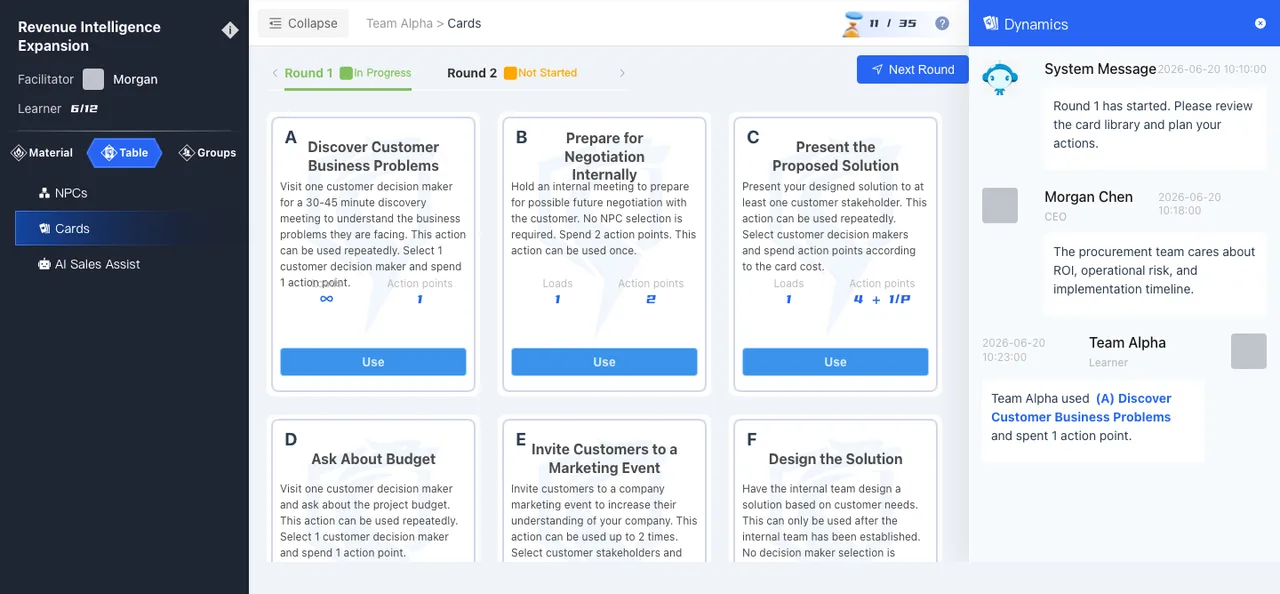
Limited action points make prioritization visible. Teams must choose whether to investigate a business problem, deepen a relationship, refine a proposal or pursue another opportunity. Those choices expose how they interpret value and urgency.
Discuss the trade-off at the moment the decision was made. A later outcome does not prove that every earlier choice was irrational. Compare what information teams had, which options they considered and how they coordinated tasks under constraints.
Rehearse when the situation changes
Stakeholder priorities and opportunity conditions can change between rounds. Participants need to reconsider a plan rather than repeat the actions that worked initially. The trainer connects those changes to the learning objective, using reviewed scenario logic.
For example, a fictional buying group may require stronger business evidence before supporting a proposal. The useful question is what the team should learn next, not how to pressure a person into agreement. The sample is a teaching situation, not a promised feature of every script.
Customize carefully, without exposing the account
Start with the account type, seller proposition and decisions the audience needs to practice. A scenario can use fictional names and altered details while retaining the decision structure. AI assists preparation; the trainer reviews factual plausibility and learner materials.
Do not upload a live account plan, personal stakeholder data or confidential procurement material without approved data handling arrangements. Decide what can be shared in training before generation, not after the content has reached participants.
Convert the learning into account questions
Debrief stakeholder coverage, evidence quality and resource choices together. Teams can identify questions to test, coordination gaps to address and assumptions to revisit on a real account. The transfer step should be specific enough for the manager to discuss afterward.
A simulation score is not a forecast or proof that one strategy will win a live deal. Pair the rehearsal with real account discovery and management judgment. Review the platform, workshop scope and commercial terms before selecting a program.
Questions before you start
Is this a voice or cold-call coaching tool?
No. SalesNail focuses on decisions across a complex B2B deal, limited resources, team collaboration and facilitator-led debriefing. Conversation practice can complement it, but the platform is not presented as a voice-scoring service.
Can we evaluate it before arranging a workshop?
Chapter 1 of The Second Curve is free without sign-up. It demonstrates individual narrative and decision mechanics, not the complete facilitated team workshop. Discuss your team objective and delivery requirements separately.
Will the simulation tell us how to win a current account?
It is a practice environment, not an oracle for a live deal. Use approved or anonymized context, review assumptions with the facilitator and validate insights in the real account.