METHOD GUIDE · CHOOSE THE PRACTICE
Sales simulation or AI sales roleplay?
Both can make training practical. Choose the format around the task: repeating a conversation, or coordinating decisions across a customer, an opportunity and a whole team.
When conversation roleplay is the closer fit
Individual roleplay is useful when the task is a specific customer conversation: a discovery opening, an objection or a value explanation. AI-based tools can offer repeatable dialogue practice; actual voice, scoring and persona capabilities depend on the provider.
Do not assume every roleplay product is limited to a single customer persona. Evaluate its real features and review how feedback is generated. Repeating a conversation can be valuable without claiming that it represents every decision in a long selling cycle.
When a team simulation is the closer fit
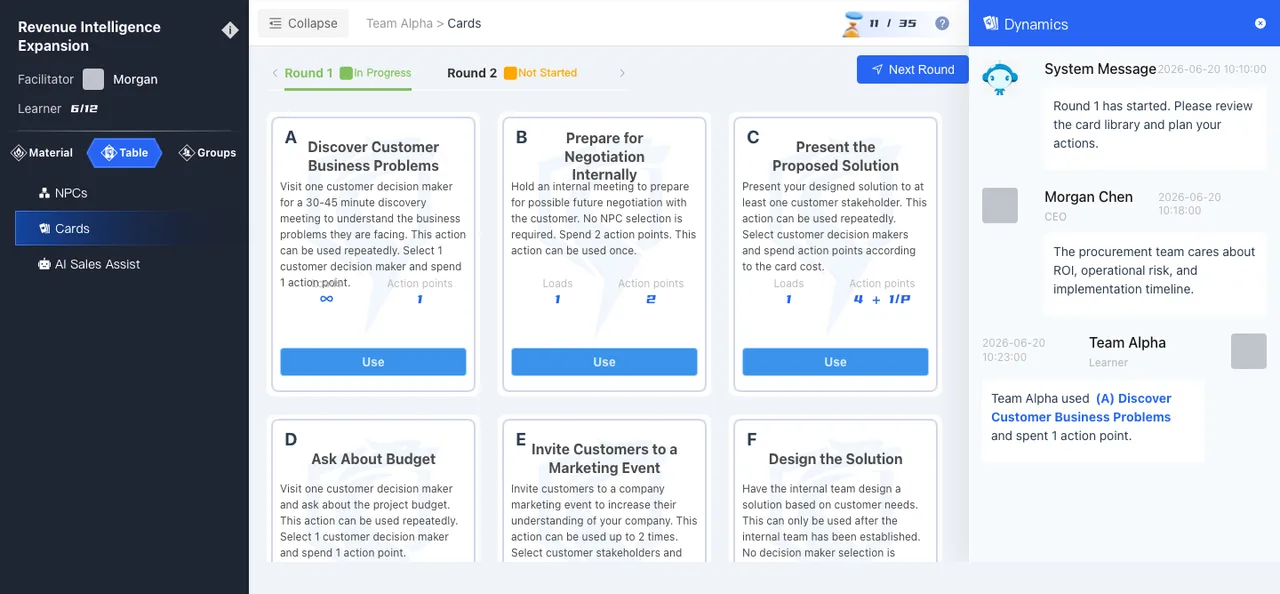
A team simulation focuses on what to do across a broader selling situation. Participants choose which stakeholder to investigate, where to allocate resources, how to coordinate expertise and when to progress a proposal. Staged consequences provide evidence for reflection.
SalesNail emphasizes that combination of shared customer context, limited actions, changing opportunities and facilitator debriefing. The difference is the learning task and delivery design, not simply the presence of an AI character or multiple roles.
Compare the evidence each format produces
For a conversation exercise, ask whether the feedback addresses the skill you want to practice and how it is validated. For a team simulation, ask whether decisions and customer interactions are observable and how the facilitator will connect them to work.
- What is the unit of practice: a dialogue or a broader deal?
- Who participates: an individual, a team or both?
- What decisions and evidence are recorded?
- Who reviews the scenario and interprets the feedback?
- How will the learning be applied afterward?
Use the methods together when the objective calls for it
A team may rehearse the overall account strategy, discover a weak discovery habit and then practice that conversation separately. Another program may introduce a conversation skill first and use a shared simulation to test where it fits in the deal.
That is a curriculum decision rather than a reason to describe every product as doing everything. Keep the expected output and commercial scope of each activity clear. A SalesNail team session is not advertised as an automated voice-scoring service.
Start with your audience and decision gap
For a kickoff or cross-functional program, begin with the team behavior and the scenario it should affect. For repeatable individual dialogue, evaluate a roleplay tool against the conversation skill. Ask for a realistic example and review the evidence, not only the demo narrative.
If you want to explore SalesNail, read how the team platform works or play the free solo first chapter. Then discuss a team scenario with the trainer or provider. The solo story introduces one format; it does not establish that your enterprise workshop is already configured.
Questions before you start
Is this a voice or cold-call coaching tool?
No. SalesNail focuses on decisions across a complex B2B deal, limited resources, team collaboration and facilitator-led debriefing. Conversation practice can complement it, but the platform is not presented as a voice-scoring service.
Can we evaluate it before arranging a workshop?
Chapter 1 of The Second Curve is free without sign-up. It demonstrates individual narrative and decision mechanics, not the complete facilitated team workshop. Discuss your team objective and delivery requirements separately.